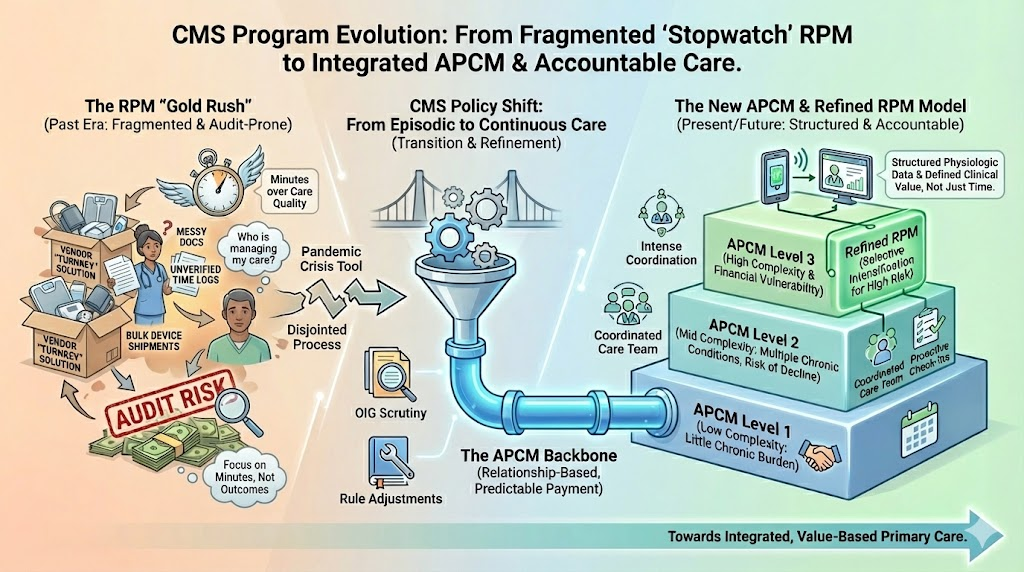
What CMS Is Actually Doing With RPM And APCM
Originally published at: https://fairpath.ai/resources/cms-rpm-apcm-2025-26
Read MoreOperational guidance and analysis for APCM, RPM, RTM, and value-based care execution.
Originally published at: https://fairpath.ai/resources/cms-rpm-apcm-2025-26
Read More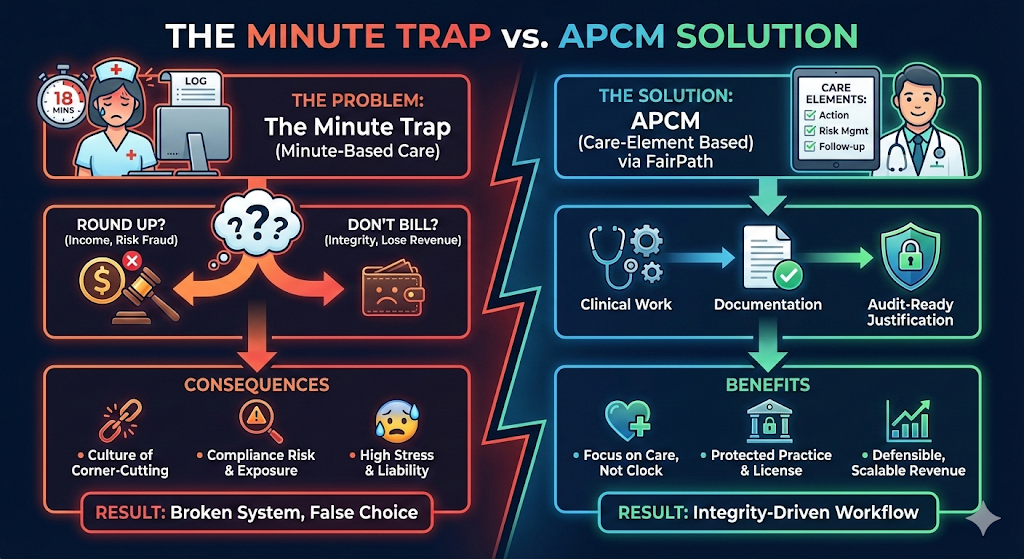
Most independent practices didn’t launch remote care programs so they could track timers, chase scattered documentation, or argue with spreadsheets at the end of every month. They adopted RPM and CCM because they believed these programs would keep patients out of the hospital, c…
Read More
Over the past several years, I’ve heard it all. Remote patient care is a scam. It doesn’t work. RPM is designed to fail. I’ve listened to the frustrations from doctors, managers, and administrators who swear that remote care is nothing but another profit scheme wrapped in good i…
Read More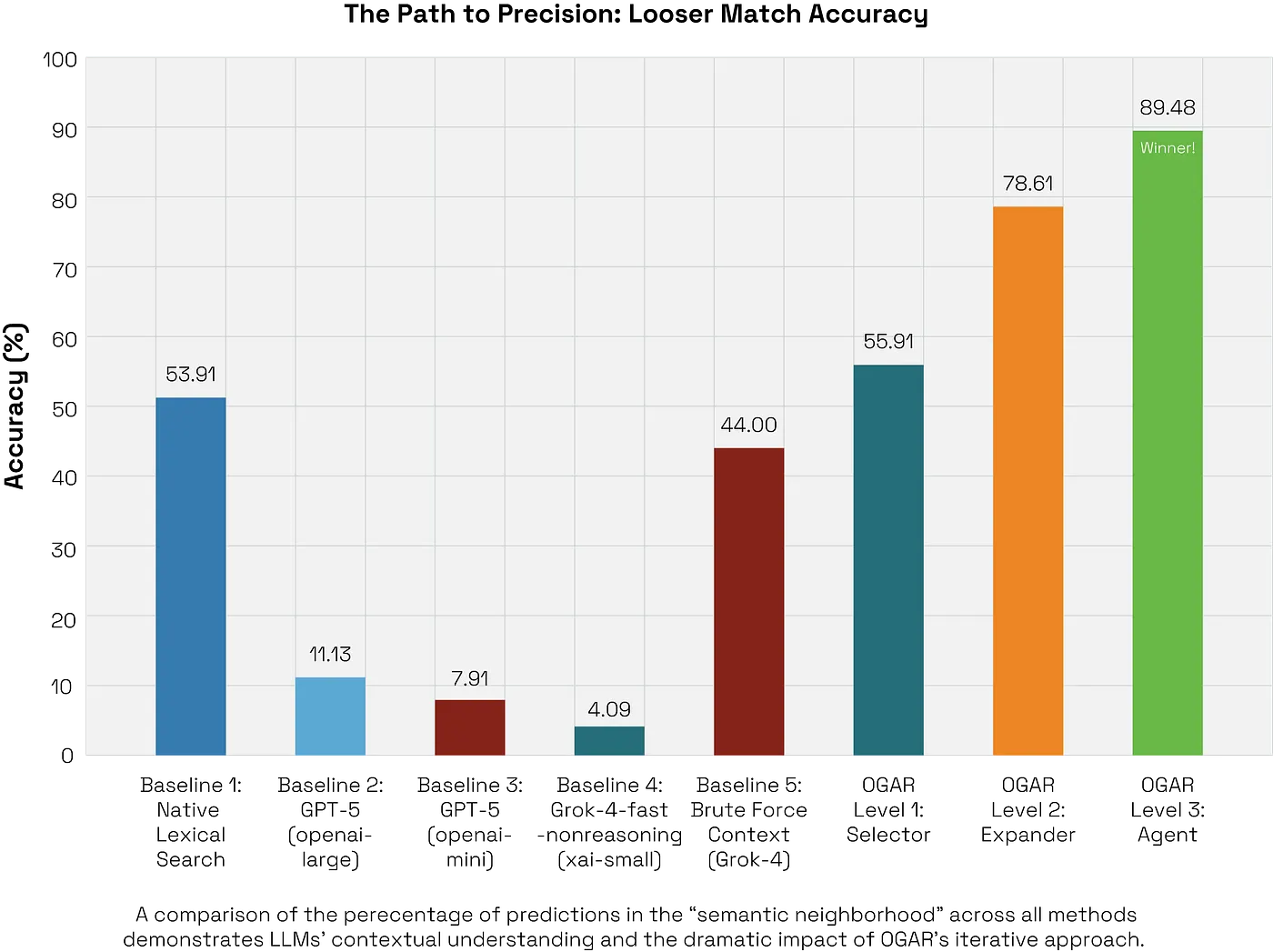
In the race to solve complex problems with AI, the default strategy has become brute force: bigger models, more data, larger context windows. We put that assumption to the ultimate test on a critical healthcare task, and the results didn’t just challenge the “bigger is better” m…
Read More
The CMS 2026 Physician Fee Schedule updates reshape how remote care coordination can be staffed, supervised, and reimbursed. Here’s what changed and how to operationalize it.
Read More
CMS is quietly reshaping how primary care teams can be paid for mental and emotional health support. Starting in 2026 (if finalized), practices using the new Advanced Primary Care Management (APCM) codes will be able to add small, monthly payments for behavioral health integra…
Read More
If your practice adopted APCM by shutting down RPM and RTM programs, you left money on the table. If you're running all three programs separately, you're burning cash on duplicate documentation and exposing yourself to compliance risk.
Read More
On January 1, CMS introduced a brand-new benefit called Advanced Primary Care Management (APCM), a monthly payment designed to roll up the core elements of care coordination under a single code. For primary care leaders, this changes the landscape in profound ways. APCM overlaps…
Read More
This blog outlines a groundbreaking proof of concept for reimagining medical ontologies and artificial intelligence. Buffaly demonstrates how large language models (LLMs) can unexpectedly enable symbolic methods to reach unprecedented levels of effectiveness. This fusion deliver…
Read More
Advanced Primary Care Management (APCM) represents one of the more meaningful changes in the CMS Physician Fee Schedule. As of January 1, 2025, practices that adopt this model will be reimbursed through monthly, risk-stratified codes rather than only episodic, time-based billing…
Read More
Primary care is carrying more risk, more responsibility, and more expectation than ever. The opportunity is that we finally have a model that pays for the work most teams already do between visits. The risk is jumping into tooling and tactics before we agree on the basics. Advan…
Read More
The Federal Trade Commission’s Sept. 12 warning to healthcare employers is a simple message with real operational consequences. Overbroad noncompetes, no‑poach language, and “de facto” restraints chill worker mobility and can limit patients’ ability to choose their clinicians. F…
Read More
Advanced Primary Care Management represents Medicare's most ambitious attempt to transform primary care economics. Unlike previous programs that nibbled at the margins, APCM fundamentally restructures how practices organize, deliver, and bill for comprehensive care.
Read More
Advanced Primary Care Management (APCM) is Medicare’s newest program, introduced in 2025 with three billing codes: G0556, G0557, and G0558. This represents a pivotal shift toward value-based primary care by offering monthly reimbursements for delivering continuous, patient-focus…
Read More
At 2 AM, a new mother in rural Alabama feels her heart racing. She's two weeks postpartum, alone with a newborn while her husband works the night shift. Her blood pressure reading on the home monitor shows 158/95. Within minutes, her care team receives an alert. By 6 AM, a nurse…
Read More
Many health systems pay $40–$80 per patient per month (PMPM) for full-service remote patient monitoring while Medicare's 2025 national averages reimburse approximately $91–$129 monthly depending on engagement time. When clinical teams can deliver the same services internally, th…
Read More
A few months ago, a physician at a 12-doctor practice in rural California called me frustrated. His practice was hemorrhaging money on readmissions, his nurses were burning out from phone tag with chronic disease patients, and his administrator was getting pressure from their he…
Read More
Medical executives today face an uncomfortable reality: while navigating shrinking margins and mounting operational pressures, many are unknowingly surrendering millions in Medicare reimbursements to third-party vendors. The culprit? Poorly structured Remote Patient Monitoring (…
Read More
Remote Patient Monitoring (RPM) has rapidly evolved from emerging healthcare innovation into a strategic necessity. Driven aggressively by CMS reimbursement policies, RPM adoption has accelerated at unprecedented rates, reshaping market dynamics and creating compelling strategic…
Read More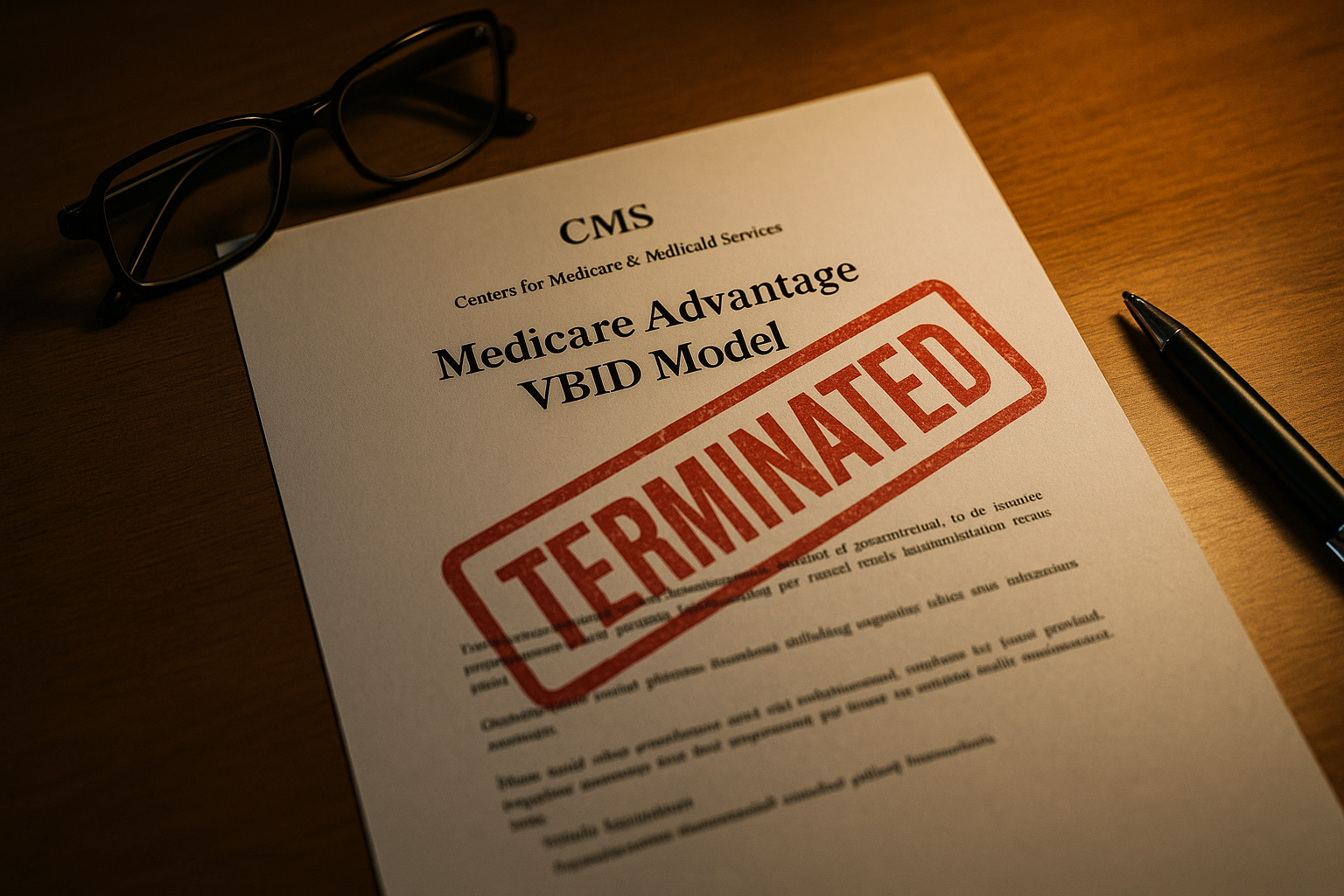
In a single December blog post, CMS just rewrote the playbook for $400 billion in annual Medicare Advantage spending. The termination of the Medicare Advantage Value-Based Insurance Design (VBID) Model (after it generated $4.5 billion in excess costs over two years) isn't just a…
Read MoreFairPath is built on operational work, not theory. We publish the playbooks and checklists we use to keep programs compliant and profitable. Use them whether you run FairPath or not.
Browse the Expert Library →The practical 2026 guide to device rules, day thresholds, management time, and audit defensibility for Remote Patient Monitoring.
Read the RPM Guide →How to run Remote Therapeutic Monitoring for MSK, respiratory, and CBT workflows with the correct 9897x and 9898x rules.
Read the RTM Guide →Calendar-month operations for CCM: consent, initiating visit, care plan requirements, time counting, and concurrency rules.
Read the CCM Guide →The operator blueprint for Advanced Primary Care Management: eligibility, G0556–G0558 tiers, and monthly execution.
Read the APCM Playbook →