Tumi Medical
"The custom platform has completely transformed the way we operate, streamlining workflows and improving patient communication."
Rachel Agusti
COO/CFO, Tumi Medical Corp
Remote care on your terms
FairPath gives your practice the software, advanced AI, workflows, and support to run APCM, RPM, CCM, and RTM with your own team.
Prefer not to operate it internally? A FairPath operator can run the program for you on the same platform, with the work and results visible to your practice.
No FairPath revenue share. Your practice keeps 100% of program collections when it operates the program internally.
Historical FairPath and operator figures, not projections. See how these figures are defined for deployment context.


FairPath connects through standard integrations, data exchange, APIs, and customer-specific workflows. The method depends on the system and deployment. Ask About My Systems
Practice and operator evidence
"The custom platform has completely transformed the way we operate, streamlining workflows and improving patient communication."
Rachel Agusti
COO/CFO, Tumi Medical Corp
Across the panel, total readings rose 12%, and 61.8% of patients improved month over month.
Read the Clinical ResultsSee how a documented eligibility workflow moved from about 45 minutes per patient to under five minutes.
See How It Was MeasuredPractices are often told to assemble the complete operation around disconnected software or hand the program to an outside service. FairPath gives you another choice.
| Decision | Software only | Outsourced service | FairPath |
|---|---|---|---|
| Who runs the work? | Your team | Outside vendor | Your team or a FairPath operator |
| Who designs the operation? | You assemble it | The vendor decides | FairPath provides the operating model |
| Visibility | Depends on what you build | Often limited to reports | Work, exceptions, and readiness remain visible |
| Economics | You keep the revenue but carry all the overhead | Usually shared or bundled into the service | No FairPath revenue share for the internally operated model |
| Flexibility | Limited by the software | Limited by the service model | Choose internal or operator-supported delivery |
Run it with your own team
FairPath identifies the right patients, routes daily work, keeps requirements visible, records evidence, and shows billing what is ready.
Use a FairPath operator
A FairPath operator can handle day-to-day program work when the practice does not want to staff it internally.
What changes Monday morning
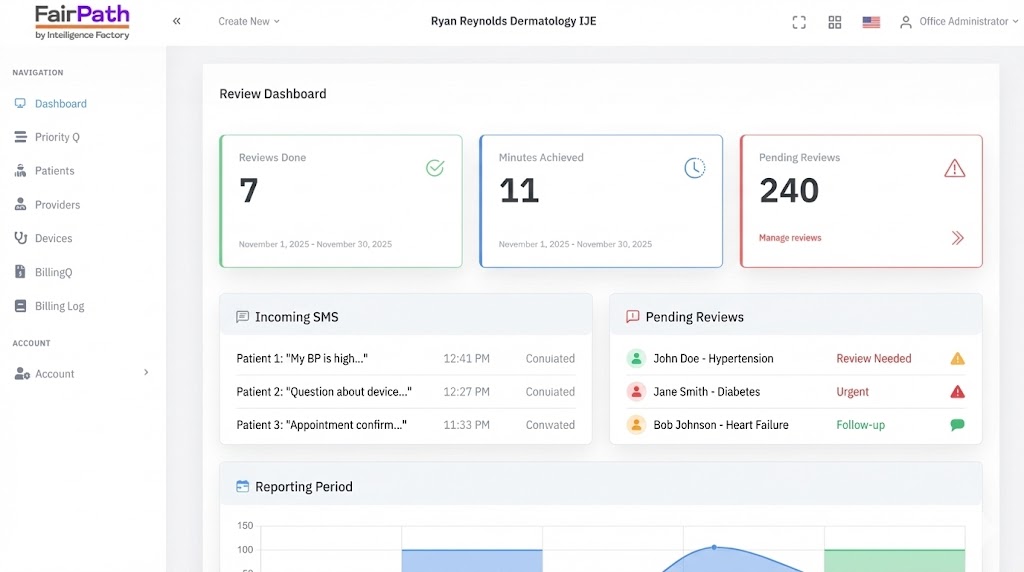
Staff can see the next work, the exceptions, and billing readiness while there is still time to act.
PriorityQ brings the next patient, the required action, and the reason forward for the correct role.
Configured in-cycle checks route payer, program, and missing-information exceptions before more work is done.
BillingQ shows what is ready, what is blocked, and the reason a record still needs attention.
Most healthcare AI writes text or suggests a next step. FairPath uses AI to perform controlled operational work around the program.
Turn an export into structured, reviewable records.
Identify missing payer and program information.
Move routine work and clinical exceptions to the correct role.
Move configured information between FairPath and systems already in use.
FairPath prepares incoming patient data, identifies missing payer or program information, routes exceptions, and creates reviewable work for practice staff.
Powered by Buffaly. See the technology inside FairPath.
Measured operating impact
These examples show the operating change behind each result. Outcomes vary by workflow, patient volume, program mix, staffing, and execution.
Starting problem: Manual insurance verification required payer-portal work that took about 45 minutes per patient.
Operating change: FairPath eligibility checks reduced the workflow to under five minutes, allowing one intake specialist to process the volume that previously required substantially more manual capacity.
Starting problem: Time was spent on patients already capped on billing units while other work stopped short of a threshold.
Operating change: Priority logic brought the most important patients and incomplete thresholds forward without removing clinical review.
Starting problem: Nurses spent about 90 seconds between tasks navigating lists to determine who to call next.
Operating change: PriorityQ served the next patient and task directly, returning time that had been lost to searching and sorting.
Next step
Prove the workflow with a defined cohort before expanding the program.
Test qualification, staffing, work routing, documentation, and billing readiness with a controlled cohort.
Launch a PilotFairPath has a separate platform, Partner Program, training system, and growth model for pharmacy operators.
Explore FairPath for Pharmacy OperatorsPractical program resources